A Sports Bettor's Introduction to Kalshi Trading
Building better sports gambling strategies means understanding where your price comes from, who is taking the other side, and what it costs to get your order filled. Kalshi and other prediction markets can feel intimidating at first, especially if you are used to FanDuel, DraftKings, or offshore books. But once you understand the mechanics, the core objective is familiar: risk capital on a sports outcome only when the price makes sense.
This is not legal, tax, financial, or accounting advice. Prediction market access, regulation, and available contracts can change. The practical goal here is to make the shift from sportsbook thinking to exchange thinking without getting lost in the terminology.
Prediction Markets Are Exchanges, Not Sportsbooks
For sports purposes, a prediction market operates much more like an exchange than a traditional sportsbook. You trade contracts tied to a particular outcome, such as a team winning a game, a total finishing over a number, or a player clearing a statistical threshold.
Those contracts have an expiration point. A sports contract resolves when the game or event is decided. If the outcome happens, the winning contract settles at $1. If it does not happen, it settles at $0.
That makes these markets feel a lot like sports betting, even if they are structured and described differently. In both cases, the real exercise is evaluating a sporting outcome, deciding whether the market price is wrong, and risking money in pursuit of a positive return.
The major difference is the counterparty. At a sportsbook, the sportsbook takes your action and manages the risk. At a prediction market, the exchange is generally matching participants. Somebody else is taking the other side of the contract.
That difference matters for building better sports gambling strategies. You are no longer simply shopping a menu posted by the house. You are participating in a market where bids, asks, liquidity, and the willingness of other participants to trade shape the available price.
Why Exchange Mechanics Can Improve Prices
Traditional sportsbooks build a hold into their markets. Across both sides of a market, that margin is how the book gets paid. Prediction markets have their own fee structures and spreads, so this is not a free lunch, but competition between independent participants can push margins much tighter.
That is a very good thing for anyone building better sports gambling strategies. Better pricing does not magically turn a bad prediction into a good one. It does mean that if you are going to make the same decision anyway, paying less for the position is better than paying more.
Prediction markets can also be powerful sources of market information. A liquid market puts a large number of opinions, orders, and information sources into one place. If you are doing top down betting analysis, ignoring that information can leave a major blind spot.
For a deeper look at the exchange model itself, see this guide to understanding sports betting exchanges.
Think in Probabilities and Cents, Not Just American Odds
The first mental adjustment is pricing. Sportsbooks usually show American odds. Prediction markets generally price a contract in cents or probabilities.
- A 50 cent contract represents roughly a 50% implied chance.
- A winning contract settles at $1.
- If you buy at 50 cents and the outcome resolves yes, the gross value is $1.
- If the outcome resolves no, the contract becomes worthless.
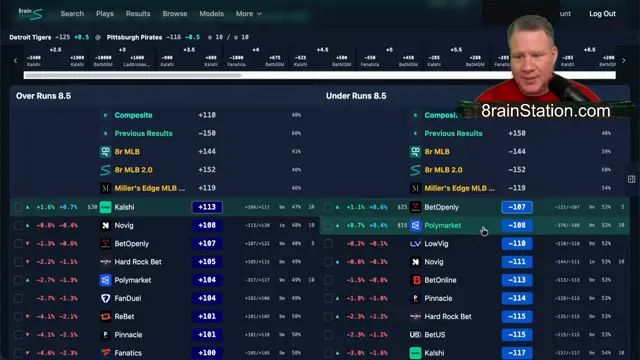
For example, a 50 cent price is approximately equivalent to +100 American odds. A 47 cent price implies about a 47% chance. A 60 cent price implies about a 60% chance.
This is actually more intuitive once you stop forcing everything through American odds. Rather than doing mental gymnastics around plus and minus numbers, you can ask a simple question: Do I believe this outcome happens more often than the price implies?
That said, American odds can be more precise than a market that trades primarily in whole cent increments. A conversion tool can help translate between the formats when comparing a prediction market against sportsbooks. This is one reason the no vig line matters so much in positive EV betting: you need a fair baseline before deciding whether a displayed price is truly valuable.
For building better sports gambling strategies, get comfortable moving between these three representations of the same idea:
- American odds: +110, -120, and so on.
- Decimal odds: Common outside the United States.
- Probability or cents: 47%, 0.47, or 47 cents.
Fees Are Part of the Real Price
Here is where many people get tripped up. Prediction markets can charge fees on the back end, rather than fully embedding the cost in the displayed contract price. The price you see while browsing is not always the full cost of the trade.
That means an apples to apples comparison with a sportsbook must be made after fees. A 48 cent contract might look attractive at first glance, but if the total debit is higher once fees are included, the actual price is not 48 cents anymore.
The fee structure can vary by contract and by how you interact with the market. Check the current Kalshi fee schedule before treating any displayed price as final.
This is crucial for building better sports gambling strategies. The edge is never just the number on the screen. The edge is the number after the spread, the fee, and the realistic likelihood of getting filled at the price you want.
Takers Get Immediate Execution, Makers Get Patience
There are two basic roles in a prediction market: the taker and the maker.
The Taker
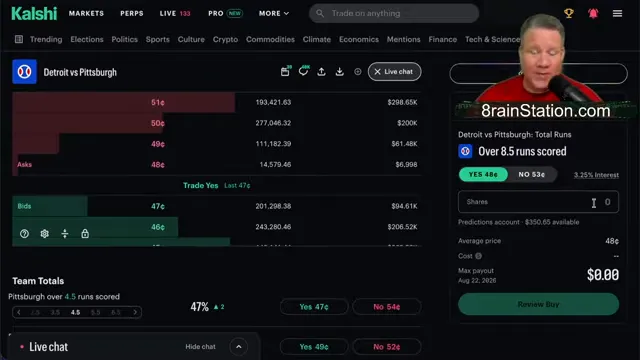
A taker accepts an order that is already available in the market. If there is someone offering a Yes contract at 48 cents and you buy it immediately, you are taking existing liquidity. Your order fills right away, assuming there is enough liquidity at that price.
The tradeoff is that takers typically pay higher fees. You get certainty of execution, but you pay for that convenience.
The Maker
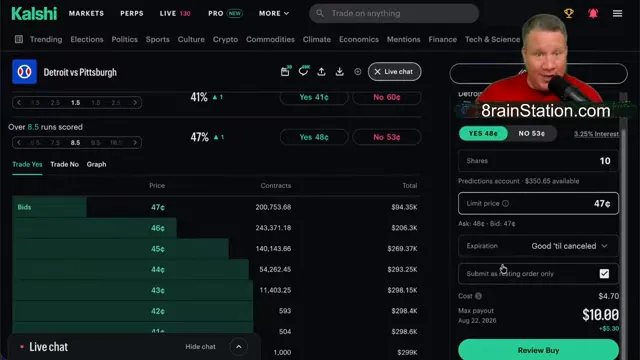
A maker posts a new order and waits for somebody else to accept it. If the current ask is 48 cents and you offer to buy at 47 cents, your order rests in the book. It may fill later, or it may never fill.
In exchange for that patience, maker fees can be lower. In the example market, posting a resting order at 47 cents avoided the extra fee that came with taking the available 48 cent offer.
This is the basic tradeoff:
- Take: Fill now, generally pay more.
- Make: Wait for a fill, generally pay less.
The irony of being a maker is that an order often fills only after the market moves against it. If someone suddenly takes your resting offer, you should at least ask why. Did new information arrive? Did you misprice the contract? Or is this simply normal movement in a liquid market?
Still, market making deserves serious attention when building better sports gambling strategies. The best advantage bettors are increasingly trying to operate on the maker side when possible, because small savings in price and fees compound over time.
Reading the Bid, Ask, and Order Book
The order book shows where participants are willing to buy and sell contracts. It is the clearest visual difference between a sportsbook menu and a tradable prediction market.
- Bid: The price somebody is willing to pay.
- Ask: The price somebody is willing to accept.
- Spread: The gap between the best available bid and ask.
- Liquidity: The amount of money or number of contracts available at each price.
In a baseball market, you might see the Yes side available at 48 cents while the No side is available at 53 cents. Those prices add to more than $1, which reflects the spread and trading friction in the market. Since the contract only settles at $1, that excess matters.
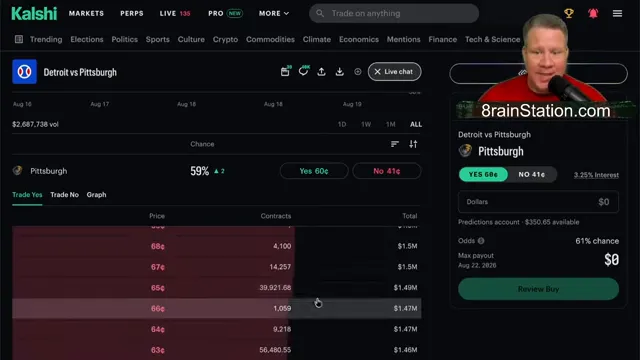
A deep order book with significant liquidity generally provides more useful price discovery than a thin market. It does not guarantee that the market is perfect, but it gives a strong snapshot of how participants collectively value the event at that moment.
When building better sports gambling strategies, do not just compare a single displayed number. Look at the depth behind it. A great price for two contracts is not necessarily useful if you need meaningful size and the next available price is materially worse.
A Baseball Example: Over 8.5 Runs
Suppose you are evaluating an Over 8.5 runs contract for Detroit versus Pittsburgh. An odds screen translates a sportsbook price into roughly a 46.95% implied probability. On Kalshi, that may correspond most closely to a 47 cent market price because contracts often move in whole cent increments.
Now imagine the current market shows:
- Buy Yes at 48 cents as a taker.
- Post a resting Yes bid at 47 cents as a maker.
- Buy No at 53 cents as a taker.
- Post a resting No bid at 52 cents as a maker.
If you choose the immediate 48 cent Yes price for 10 contracts, the displayed contract cost may be $4.80, but the actual debit can be higher after fees. In the example, the total cost was $4.89. That extra nine cents is the practical cost of taking liquidity.
If you instead post at 47 cents as a resting maker order, the cost is $4.70 for 10 contracts. The downside is obvious: there is no guarantee that your order gets filled. The upside is equally obvious: a one cent better entry plus lower fees can matter a great deal over a large sample.
This is exactly the kind of execution decision that separates casually placing a bet from deliberately building better sports gambling strategies. Is it worth paying up to participate now, or is your edge strong enough to justify waiting for a better price?
Remember: This Is Still a Negative Sum Environment
It is important not to confuse sports contracts with passive stock market investing. Stocks represent ownership in businesses, and broad equity markets have historically benefited from a growing economy and increasing productivity over time.
Sports markets do not have that same growing pie. One side wins, one side loses, and fees or market friction come out of the total pool. In aggregate, this is a difficult game. To win over time, you must be better than average and overcome the costs of participating.
That does not mean there is no opportunity. Professional bettors, sophisticated groups, and disciplined advantage players exist for a reason. It does mean that building better sports gambling strategies requires honesty about the challenge. A prediction market may offer better prices than a sportsbook, but it does not eliminate the need for an actual edge.
How to Approach Kalshi Without Getting Overwhelmed
The Kalshi interface can be busy. There are multiple categories, markets, perpetual contracts, event markets, charts, and order types. Do not try to understand every part of it at once.
Start with a sport and market type you already understand. If you know MLB moneylines, totals, run lines, or player props, begin there. Then take the time to inspect the contract language, the settlement criteria, the bid and ask, available liquidity, and the full cost of the order.
A practical process for building better sports gambling strategies on a prediction market looks like this:
- Identify a familiar game and market.
- Translate the contract price into implied probability.
- Compare that probability with sportsbook prices and a fair market baseline.
- Check the bid, ask, available liquidity, and contract resolution rules.
- Calculate the actual cost after fees.
- Decide whether immediate execution is worth taking liquidity.
- If not, post a resting maker order at a price that preserves your edge.
- Monitor the market and be willing to reassess if meaningful information changes.
Do not treat a limit order as a free upgrade. A maker order that fills after a major market move may have been good when you posted it and bad when it gets hit. That is why execution, information, and risk management all belong in the same conversation.
The Bottom Line
Kalshi trading is not just sportsbook betting with different labels. It is a different market structure with different incentives. You are trading contracts against other participants, prices are expressed as probabilities, and patience can be rewarded through lower maker fees.
For anyone focused on building better sports gambling strategies, the opportunity is straightforward: learn to compare true post fee prices, use prediction markets as information sources, and consider whether a better resting price is worth waiting for.
The goal is not to blindly take every price or pretend that lower margins make sports markets easy. The goal is to understand the game well enough to make better decisions inside it. Keep learning, pay attention to the mechanics, and get your edge before you put capital at risk.