Bet Sports like a Portfolio Manager
Building better sports gambling strategies means getting past the idea that one good bet is enough. It is not. If you are serious about building better sports gambling strategies, you need a repeatable way to search, compare, filter, and assemble advantage plays like a real portfolio.
That is the whole point of the latest search upgrades here. This is not just a prettier screen. This is a shift in how you think about price, risk, opportunity, and execution. The big unlock is market hold, plus a cleaner flow for collecting plays, comparing both sides, and deciding whether a bet belongs in your portfolio at all.
If you want to sharpen your process even further, the Pregame Plays Search breakdown pairs naturally with what is covered here.
The search page now separates finding bets from displaying bets
The first important change is structural. The search page now treats search criteria and display options as related but separate things.
That matters because these are not the same job.
- Search decides what comes back.
- Display decides how you want to look at it.
That sounds small until you use it. Once those jobs are separated, the page becomes much more flexible. You can run one strategy, then instantly change how you inspect it without rebuilding the whole search from scratch.
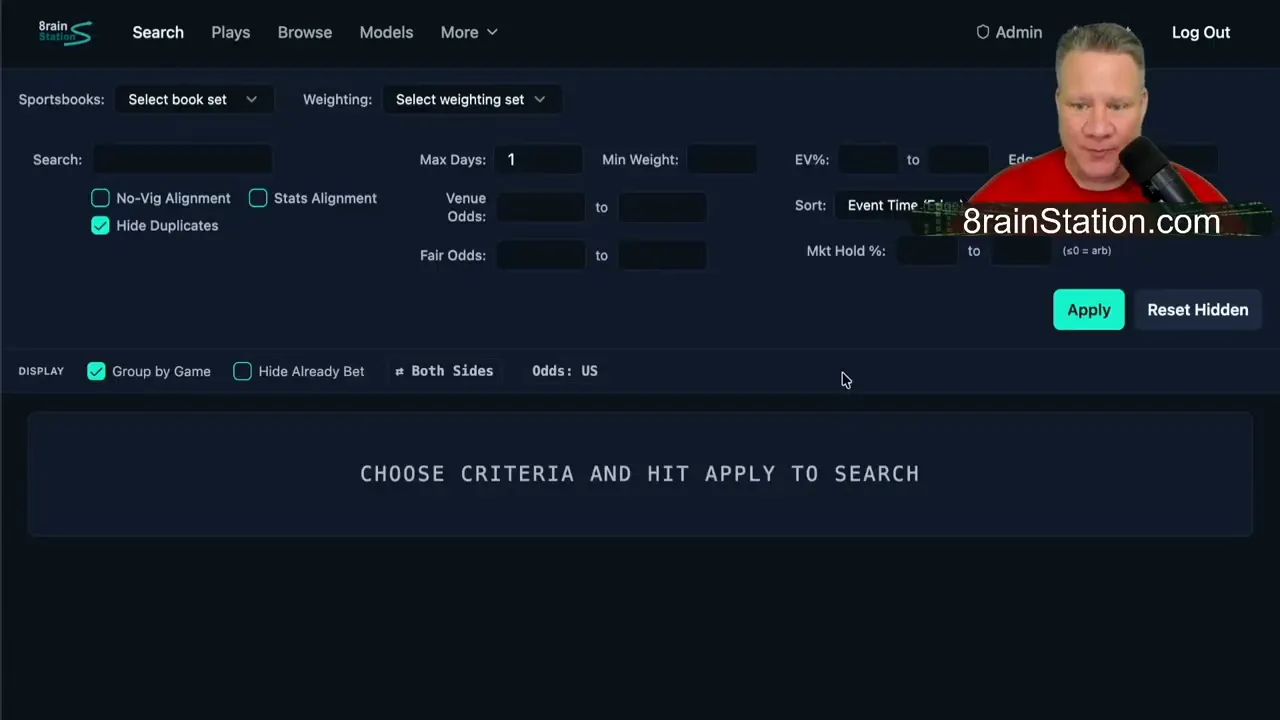
You will also notice some controls have moved. Group by game, hide already bet, and the new both sides option live in the display area. That is deliberate. The goal is to keep the actual edge-finding logic clean while letting you inspect the board in different ways.
Why market hold changes everything
The star of the update is market hold percentage. If you are building better sports gambling strategies, this metric is not optional fluff. It tells you how expensive the market is to bet into.
Low hold is good. Negative hold is even more interesting.
Why? Because the tighter the prices on both sides, the less friction you are fighting. When the market gets close enough, or even crisscrosses, you are staring at either a very efficient market or a straight-up arbitrage situation.
Think about what that means in practice:
- A 5 percent or 6 percent hold market demands more from your edge just to break through the cost.
- A 2 percent hold market is cheaper and easier to attack.
- A 0 percent or negative hold market can become a direct arb or at least a very high-quality pricing environment.
That is why market hold is such a powerful filter. It is not merely telling you what your model likes. It is telling you how much you are paying for the right to bet it.
Use market hold to cut a crowded slate down to real opportunities
One of the easiest mistakes in sports betting is drowning in too many possible plays. A model spits out a big list, and suddenly everything looks playable.
That is where market hold earns its keep.
In the example shown, filtering model plays by a market hold better than 2 percent slashes the result set from a huge pile of plays down to a much smaller group. Nothing magical happened to the model. The difference is that now you are only looking at bets in markets that are not charging you a ridiculous tax.
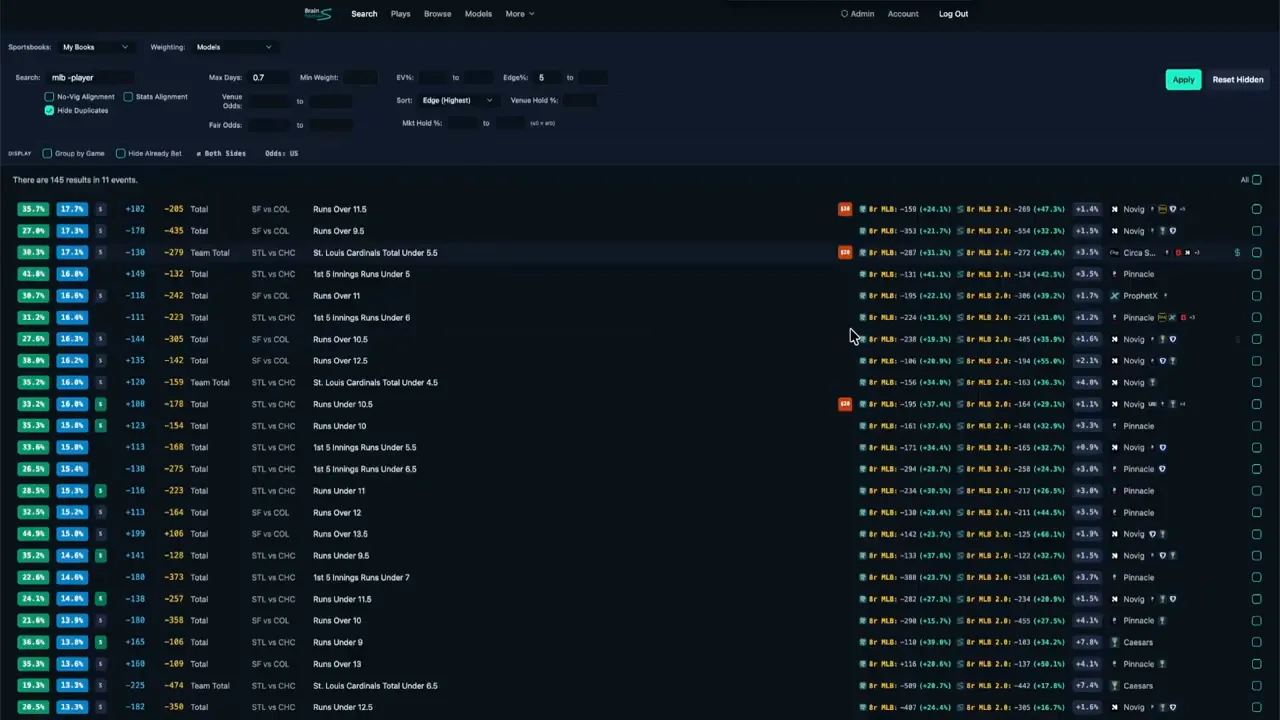
This is one of the cleanest ways of building better sports gambling strategies because it adds another layer of triangulation:
- What does the model think?
- What is the market doing?
- How expensive is the market itself?
A play can still look attractive on raw edge alone, but if the hold is bad enough, you may choose to pass. That is not being timid. That is being selective.
Why the interface stopped encouraging random pruning
Another design change matters more than it may appear at first glance. The old habit of trimming a search result set one click at a time is no longer the focus.
Instead, the flow is now built around adding bets you want to a portfolio, then managing that portfolio with intention.
That change fixes two problems.
- It shifts your mindset. You are no longer thinking like someone casually deleting rows from a table. You are thinking like someone constructing a book of positions.
- It reduces mistakes. If action controls and remove controls live too close together, accidental clicks become inevitable.
You can still click straight into a play and make the bet if that is your style. Nothing is being taken away from the opportunistic bettor. But the broader system is now pointed toward portfolio construction because that is where building better sports gambling strategies actually lives.
The both sides view turns a one-way list into a market analysis tool
The new both sides display is a monster upgrade.
Originally, it may have seemed like this would require a separate search. It does not. It works as a display layer, which is exactly right. Once a market is already in your result set, you should be able to instantly flip into a two-sided view and understand the full pricing picture.
That means you can:
- See both sides of the market immediately
- Spot no-cost or better pricing environments
- Evaluate straight bets and arbitrage off the same screen
- Get context for line movement and outlier pricing faster
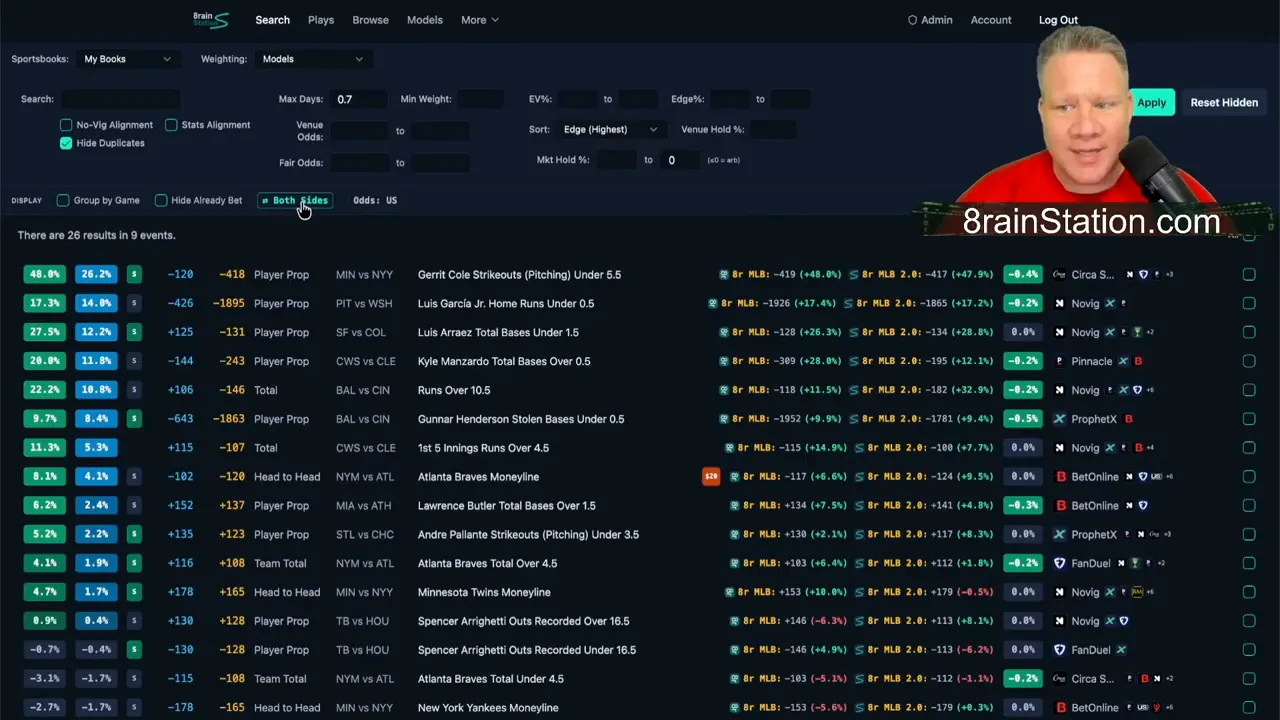
This is where building better sports gambling strategies starts to feel less like guesswork and more like controlled market selection. You are not just scanning for a bet. You are reading the shape of the market.
How to search for no-cost and arbitrage markets
One of the slickest use cases is setting the max market hold to 0 percent.
That tells the system to return only markets priced at a true coin flip or better. At that point, you are looking for markets where there is effectively no hold or even negative hold. Those are prime spots for:
- Arbitrage
- Promotion conversion
- Price-sensitive directional bets
- Situations where outlier books can be attacked cleanly
When this filter was applied to player props, the result count collapsed from hundreds of possibilities to a tiny set of truly interesting opportunities. That is the whole game. Not more noise. Better noise reduction.
And when one of those filtered markets shows a weird split, maybe a sharp side at one book and a standout outlier at another, now you have a much richer decision tree:
- Take the obvious arb
- Play one side only
- Use one side as a promotional conversion leg
- Fade the outlier if the broader market is telling a different story
If arbitrage is part of your process, this pairs nicely with a deeper look at arbitrage betting workflows.
Arbitrage is now practical, not theoretical
Arbitrage used to be something people talked about more than they executed well. It was too clunky, too slow, or too fragmented.
Now, once you spot a negative hold market, you can flip to both sides, select the market, and work directly with the arb calculator. That makes the process immediate.
You can quickly see:
- The two prices you are pairing
- The amount to place on each side
- The equalized payout
- The actual profit amount
Is every arb huge? Of course not. Sometimes the profit is coffee money. But that misses the point. The point is that the workflow is finally smooth enough to act on real opportunities when they appear.
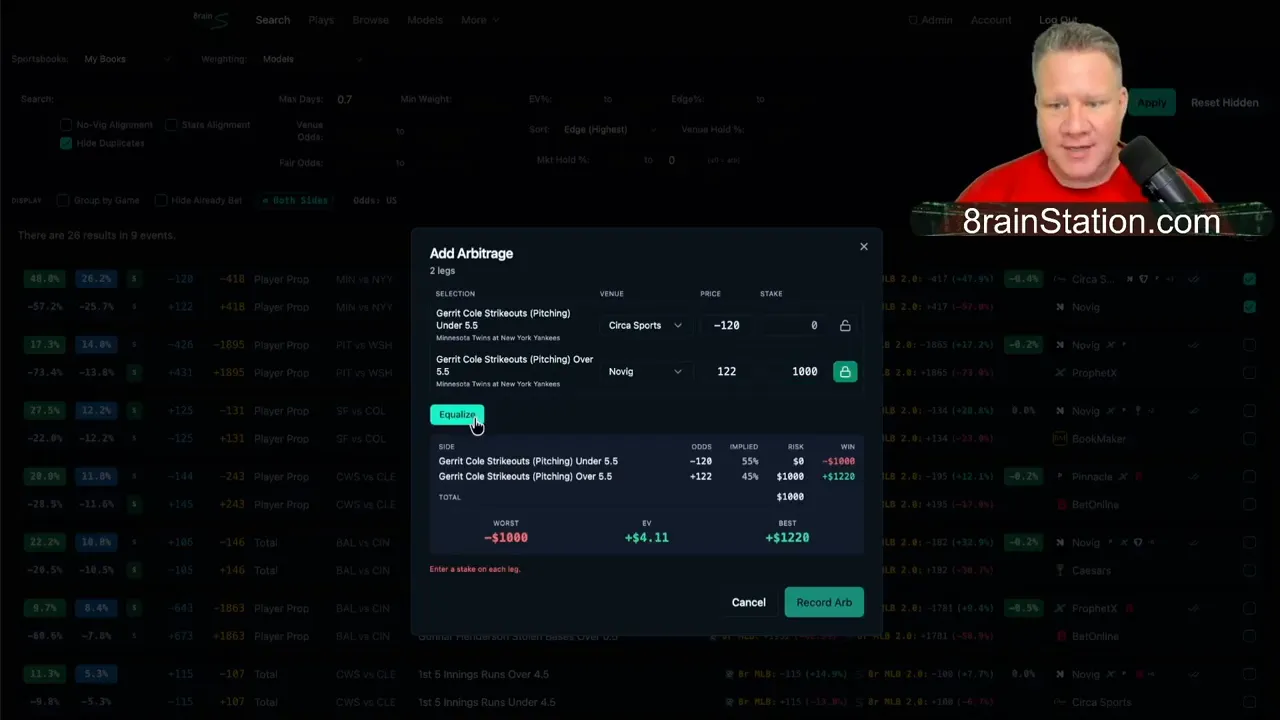
More importantly, the arbitrage view does not have to compete with model-based betting. You can use both together. That is where things get fun.
Combining EV filters with market hold creates elite targeting
This is where the platform really starts behaving like a quantitative search engine instead of a generic odds board.
You can stack filters such as:
- Minimum EV threshold from your model
- Maximum market hold threshold
- Specific sportsbooks
- Market type like player props
For example, if you ask for plays with at least 3 percent EV and an advantageous market hold, the result is not just a list of model picks. It is a curated subset of model picks sitting inside attractive pricing environments.
That is a very different thing.
It means your edge screen is now doing two jobs at once:
- Finding plays your model likes
- Confirming that the market structure is friendly enough to justify action
That is one of the clearest examples of building better sports gambling strategies because it forces discipline. You are no longer accepting every positive EV output as equal.
Why this helps you find needles in the haystack
On a typical slate, you may start with 400 possible plays. Most of them are not worth your time. Some are overpriced. Some are low-quality edges. Some are just not the best version of what you could be doing with your bankroll.
The combination of EV, market hold, display controls, and both-sides analysis lets you cut those 400 down to five, six, or seven highly actionable situations.
That is the payoff.
Building better sports gambling strategies is not about having more data. It is about having the right filters so the data serves a decision.
Line movement context matters more when the market is tight
Another benefit of the new flow is how much easier it is to read market movement in context. Once you identify a tight or no-cost market, line movement becomes more informative.
If multiple books are drifting one way while one book hangs a stale price, that stale number becomes a lot more meaningful than it would in a fat, expensive market.
That is especially useful in player props, where outlier prices can show up briefly and disappear quickly. Instead of scrolling blind through hundreds of rows, you can isolate the markets where movement and price quality are both worth your attention.
And when you want a more detailed breakdown of a specific wager before acting, the Bet Details Screen overview is the natural next step.
The interface is being tuned around what matters most
You may notice that some fields disappear as the screen zoom changes. That is intentional. The interface is being tightened around the most important information on the page.
In other words, not every data point deserves equal visual weight.
The current direction is clear:
- Prioritize the metrics that drive decisions
- Reduce clutter when space gets tight
- Keep room for future customization
- Support fast switching between American and decimal odds
The odds format toggle is also instant, which matters more than people think. Sometimes seeing the opposite side or a pricing relationship in another format gives you cleaner intuition right away.
This is quantitative enrichment, not just a list of bets
The deeper idea behind all of this is simple. The goal is not to spit out random picks. The goal is to enrich your betting decisions quantitatively.
That means whether you are using:
- In-house models
- Your own models
- Arbitrage hunting
- Promotion conversion
- Book-specific searches
you now have a system that helps you understand the market around the play, not just the play itself.
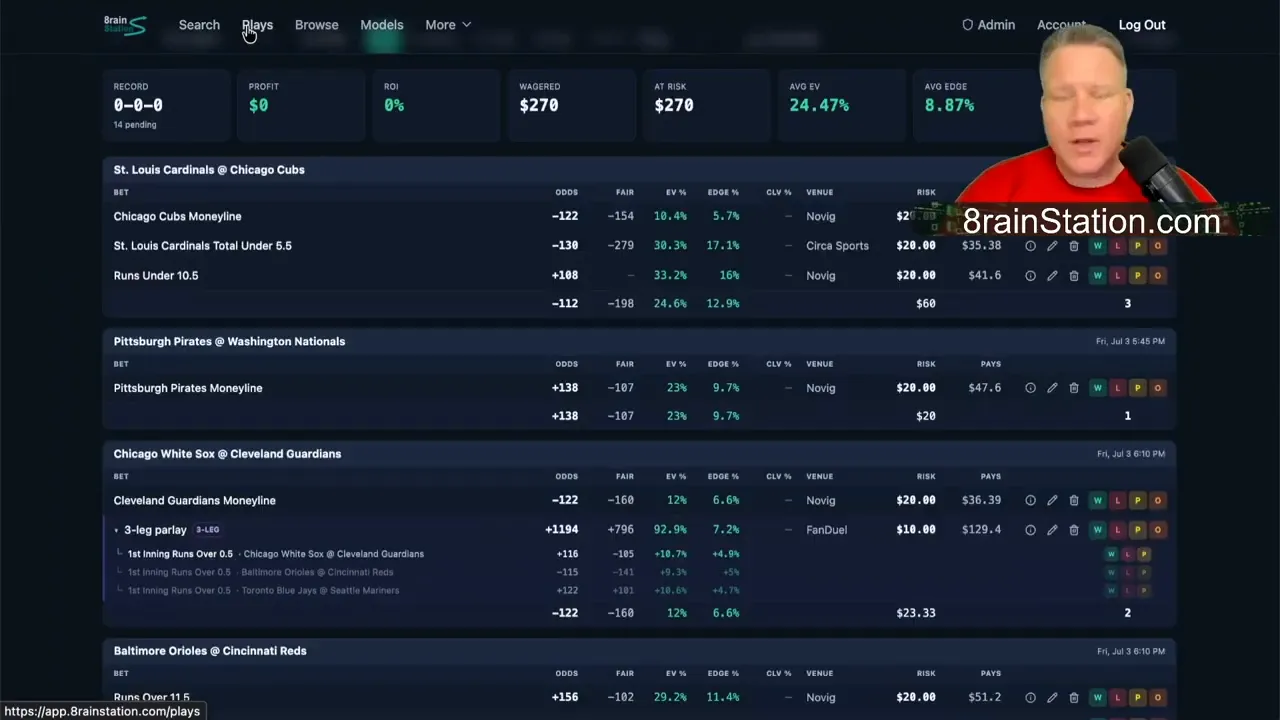
That is what building better sports gambling strategies actually looks like in practice. You stop asking, “Do I like this bet?” and start asking, “Does this bet belong in my portfolio, at this price, in this market, with these other positions already on?”
Low-hold searches are useful far beyond straight arbs
It is worth repeating that low-hold search is not only for direct arbitrage. You can define low hold however you want:
- 1 percent
- 2 percent
- 3 percent
That flexibility matters because different strategies need different levels of pricing efficiency.
Examples include:
- Converting bonus bets or promos in a low-friction market
- Hunting one-sided value where the market is highly liquid
- Comparing books with tighter spreads against books with stale outliers
- Reducing cost on bets where your edge is modest and price sensitivity matters
So yes, negative hold is sexy. But simple low-hold filtering may be just as valuable over the long run.
The real shift is mental
The biggest upgrade here is not a button, a filter, or a calculator. It is a mental shift.
You are being pushed away from casual bet-picking and toward a portfolio mindset.
That means:
- Selecting only the best-priced versions of your edges
- Understanding how market cost affects expected return
- Seeing both sides before acting
- Using multiple search strategies to feed one decision framework
- Pruning your portfolio, not just your search results
That is the future. And frankly, not many people are building toward it this way.
Final thought on building better sports gambling strategies
Building better sports gambling strategies is about putting the right instrument in your hand and knowing what song you want to play.
The tools are here to search tighter markets, identify zero-cost opportunities, compare both sides instantly, and assemble plays with real portfolio awareness. Whether you are a model bettor, an arb bettor, a promo grinder, or some hybrid of all three, the core idea is the same:
Do not just find bets. Build a portfolio of advantage plays.
If you want to explore the platform directly, check out 8rain Station. For more strategy discussion and community chatter, the free Discord and X links are available from there as well.