The Advantage Sports Betting Technique Nearly Everyone Does Wrong
Most people who talk about building better sports gambling strategies are still playing the wrong game.
They hunt for isolated plus EV plays, one line at a time, one screen at a time, and then wonder why their process feels messy, disconnected, and harder than it should be. The real job is not just finding bets. The real job is managing how you allocate money, time, exposure, and execution across an entire day.
That is the shift that matters. Not bet finding. Portfolio management.
Stop treating every bet like a standalone event
If you are serious about advantage sports betting, you have to stop thinking in terms of random tickets and start thinking in terms of a daily portfolio.
A lot of tools in the market still act like the whole job is this:
- Here is a play
- Go bet it
- Here is another play
- Go bet that too
That hand to mouth approach is exactly where people lose the plot. Even if the individual plays are good, the overall exposure can be sloppy. You can end up too concentrated in one game, too aggressive on one side of the market, overcommitted to one sportsbook, or simply risking more than the day actually calls for.
That is why serious strategy has to start with a different question:
How do I want to invest my resources today to best meet my objectives?
That means your bankroll matters. Your time matters. Your total risk matters. Your execution path matters. And yes, the plays matter too, but only as ingredients in a larger portfolio.
If you want more background on how exposure can stack up across related positions, it is worth understanding highly correlated bets in sports betting because portfolio thinking starts there.
Two model styles, two different kinds of opportunity
The example process here starts with two baseball model approaches side by side.
One model is more centered and conservative. Think of it as the steadier baseline. The other is a second generation model that is more aggressive and more willing to lean into softness and opportunity. It is less proven, but potentially sharper.
That contrast matters because not every model is doing the same job.
- The steadier model is closer to a most likely scenario approach.
- The aggressive model is more about spotting where the market may be especially vulnerable.
When those two approaches start to diverge, you learn something useful. You are not just asking whether a single line is good. You are asking what kind of edge you are dealing with, and how much confidence you want to place behind it.
Start with a candidate list, not a final betting card
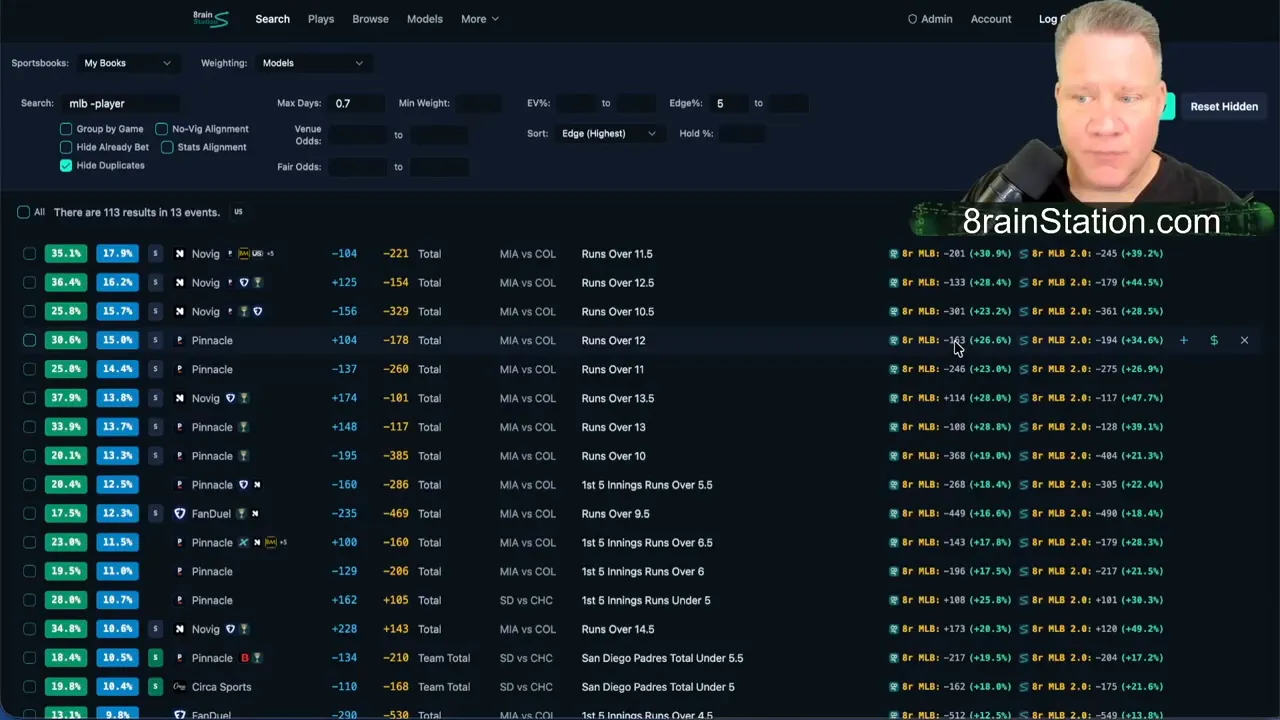
One of the smartest parts of this workflow is that the first search is not the place where you make all your final decisions. It is where you gather raw material.
That means pulling together a candidate list from model outputs, often with a minimum edge threshold. In the example shown, the threshold is 5 percent, which is meant to surface situations where the model and market are meaningfully apart.
From there, the idea is simple:
- Search for opportunities
- Add the most interesting ones to a working portfolio
- Prune and shape that collection later
This is a much better way to build a daily card than forcing every decision at the moment you first see a line.
In the baseball example, that meant selecting a mix of totals, first five looks, and a few laddered positions. Not because every one of them must be played, but because they deserve a place on the workbench.
That distinction matters. A candidate list is clay. It is not the sculpture yet.
The big workflow change: manage from the plays page
The most important structural shift is this: the real work happens after the search.
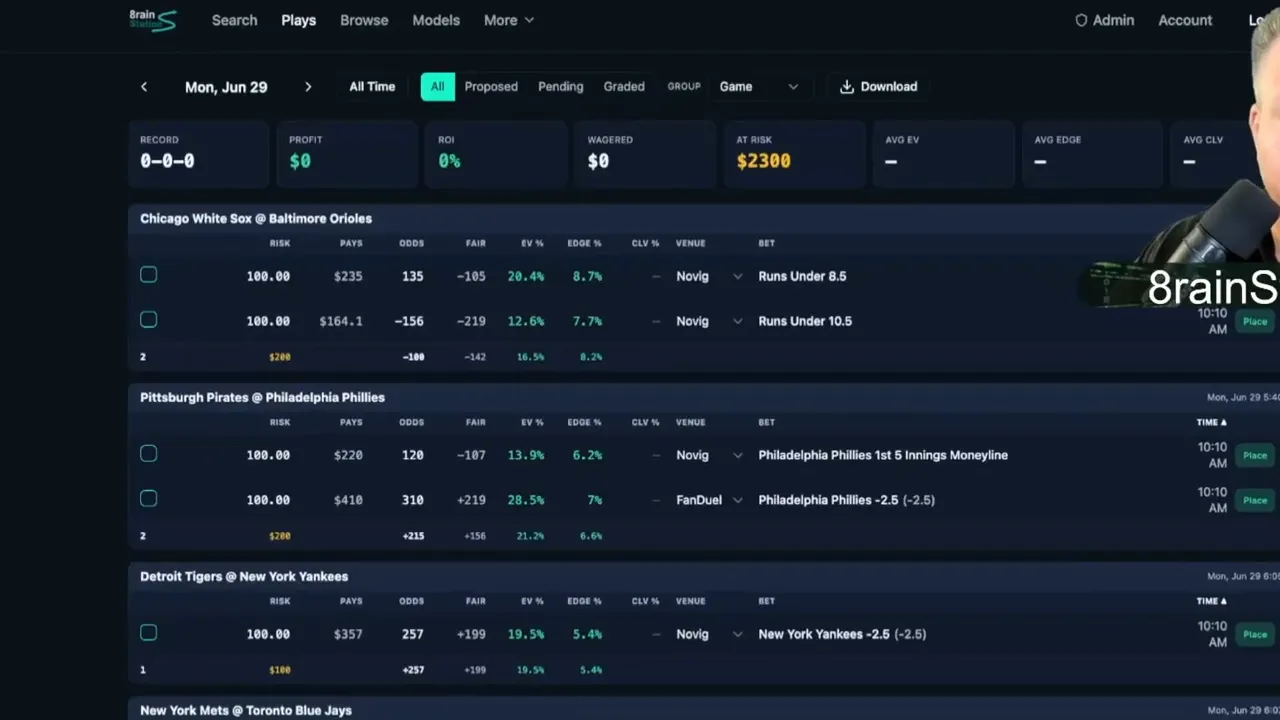
Once the candidate plays are added, the center of gravity moves to the plays page. That becomes the operational hub for the day.
Instead of working only at the search level, you can now look at the entire collection and make decisions with context. You stop reacting to one bet at a time and start evaluating your full portfolio.
From there, you can:
- Group plays by game
- Sort by edge or EV
- Review average pricing and risk
- Prune overexposure
- Prepare execution by sportsbook
Add other markets without losing the bigger picture
Once the initial game markets are in the portfolio, the process can widen out. In the example, the next pass searches player props with the same minimum edge filter and adds a handful of the strongest ones to the same portfolio.
That is an important point.
You do not need separate mental universes for sides, totals, first fives, and props. If they are all part of the same bankroll and same day, they belong in the same risk picture.
That alone is a huge upgrade. It helps answer practical questions like:
- Am I overexposed to one team?
- Am I carrying too many aggressive prices?
- Do I have too much tied up in props versus game markets?
- Am I risking more overall than I intended?
Those are portfolio questions, not isolated bet questions.
Prune by game before you obsess over individual bets
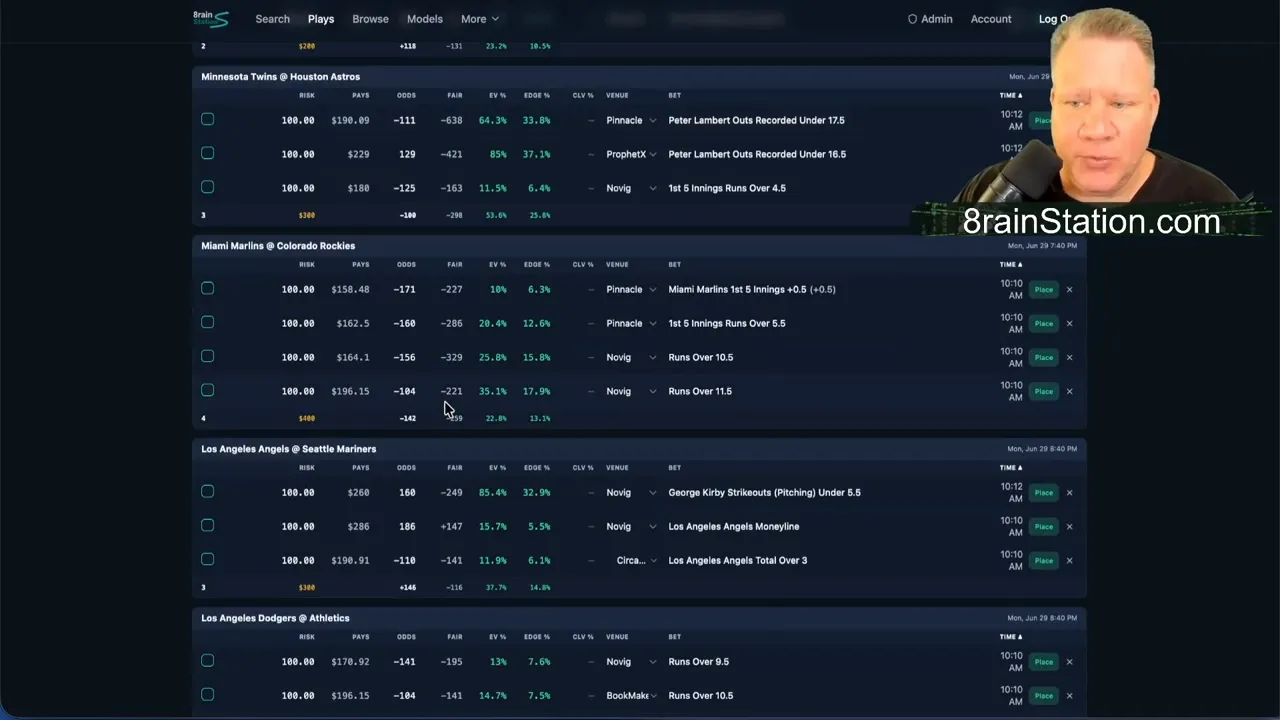
One of the best uses of the plays page is pruning by game.
Suppose a single matchup throws off multiple attractive positions. That can happen naturally when a model sees a real disconnect. But that does not mean you want unlimited exposure there.
Maybe your rule is no more than two plays per game. Maybe it is no bad teams. Maybe it is no heavy concentration on markets you personally know are more volatile. Whatever the rule is, this is where it gets applied.
The process becomes:
- Group by game
- Review how many bets are clustered in each event
- Cut the ones you do not need
- Keep the strongest and most intentional exposure
That is disciplined portfolio construction. You are making sure your final card reflects risk management, not impulse.
Sort the portfolio through different lenses
Once the portfolio exists, you can start interrogating it from different angles.
That is where this gets fun, because you are no longer staring at a flat list and pretending every position is equal. You can sort and regroup the card to answer different questions.
By aggressiveness
What are the boldest prices in the portfolio? Are you carrying too many long shots or heavy underdogs? If so, maybe trim some of that heat.
By EV percentage
Which positions are mathematically strongest? Which ones are merely acceptable and which ones feel too thin once stacked next to the best opportunities?
By game
Are you too concentrated in a particular matchup? Are several bets effectively telling the same story?
By market type
How much of your portfolio is totals versus sides versus props? That kind of market mix matters more than most people admit.
By sportsbook or venue
How should you actually execute the card efficiently once you have decided what to keep?
This is what separates random plus EV clicking from real process. Every sort order becomes a risk lens.
Bet sizing belongs at the portfolio level too
Another key idea is that sizing should not be treated as an afterthought.
If the portfolio grows too large for the day, the answer is not always to delete half the board. Sometimes the right answer is simply to scale the entire collection down.
That is why the ability to adjust bet size across the whole card matters. Maybe 25 bets at 100 dollars each is more risk than you want. Fine. Reduce the entire set to 20 dollars or 25 dollars each and keep the structure intact.
That kind of bankroll first discipline is central to serious strategy. If bet sizing is a weak point for you, this is a good companion read on bet sizing and the Kelly Criterion.
The principle is straightforward:
- First decide what level of daily exposure makes sense
- Then decide how many positions deserve inclusion
- Then set sizing in a way that fits both
That is much better than stumbling into a bloated card and realizing too late that you built something you never really meant to build.
Execution is its own separate step
This is another mindset shift that too many bettors miss.
Finding plays and placing plays are not the same task.
First you build the portfolio. Then you execute it efficiently.
When the portfolio is ready, sorting by venue or sportsbook makes the actual placement cleaner. Instead of bouncing around the board in random order, you can move sportsbook by sportsbook and get the work done quickly.
That sounds small, but it is not. It cuts friction, reduces mistakes, and keeps you oriented to the whole position rather than fragmenting your attention.
Good operators separate analysis from execution. That is a huge part of professional process that often gets ignored.
Parlays should be built from vetted plays, not from impulse
Parlays are another place where process usually falls apart.
Most people build parlays in a disjointed way. They see a play, start dreaming about combinations, and lose all sense of structure. A much better method is to decide which plays are worthy on their own first, then decide whether any of them should be packaged together.
That turns parlays into an execution choice rather than the starting point.
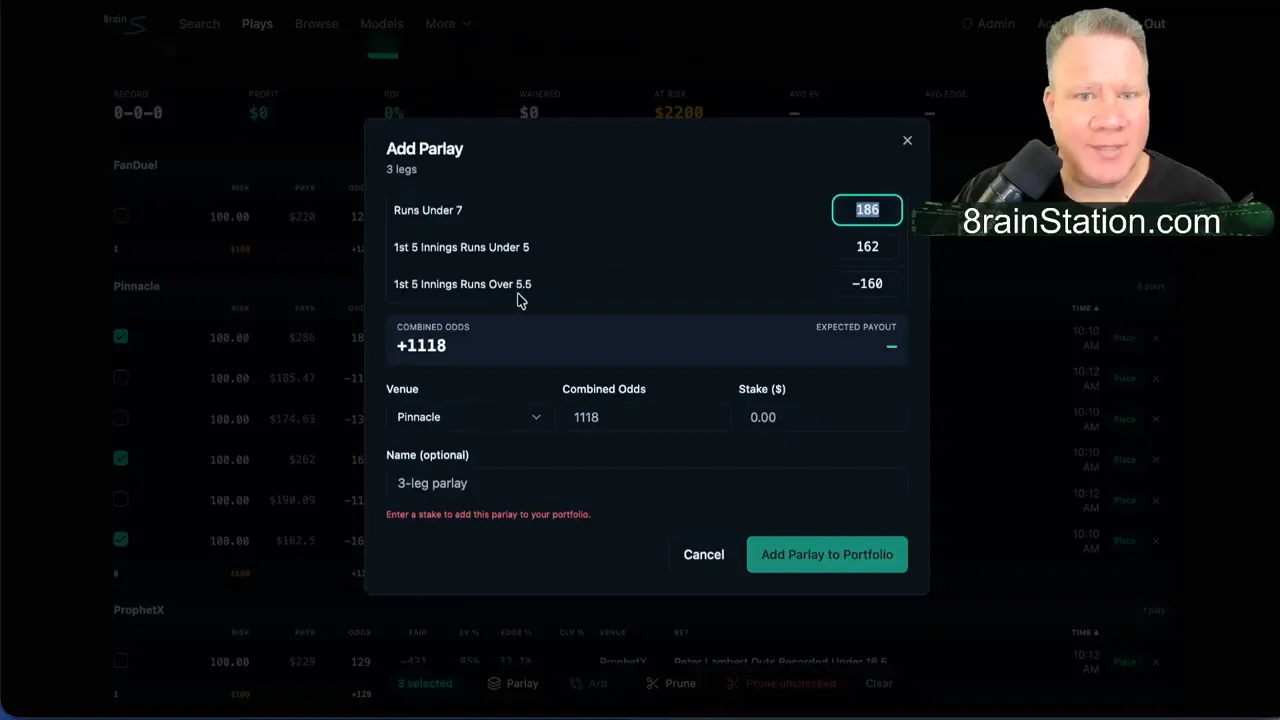
That framing matters because a parlay is usually not some magical strategy boost by itself. In many cases it functions more like financing or packaging. Sometimes that packaging matters because of promotions, cover, or convenience. But the main point is that the underlying plays should already be good.
If you want a deeper breakdown of that thinking, here is a useful article on understanding parlays in sports betting.
So the cleaner process is:
- Decide whether each play is worth having in the portfolio
- Prune the card
- Only then decide whether to execute certain combinations as parlays
That is another example of separating good decision making from flashy decision making.
Arbitrage is not just for hunting free pennies
The arbitrage tool shown here is where the portfolio approach really starts to flex.
Yes, you can use arbitrage in the obvious way by finding offsetting over and under positions on the same total and balancing them. But the bigger idea is not just locking in a tiny edge. The bigger idea is managing exposure dynamically.
That means arbitrage can help when:
- You want to hedge an existing position
- News drops and you need to back out of risk
- You want to blend outcomes intentionally
- You want to compare worst case, expected case, and best case returns
That is miles more powerful than the childish version of arbitrage where the only thought is, can I scrape a risk free coffee here.
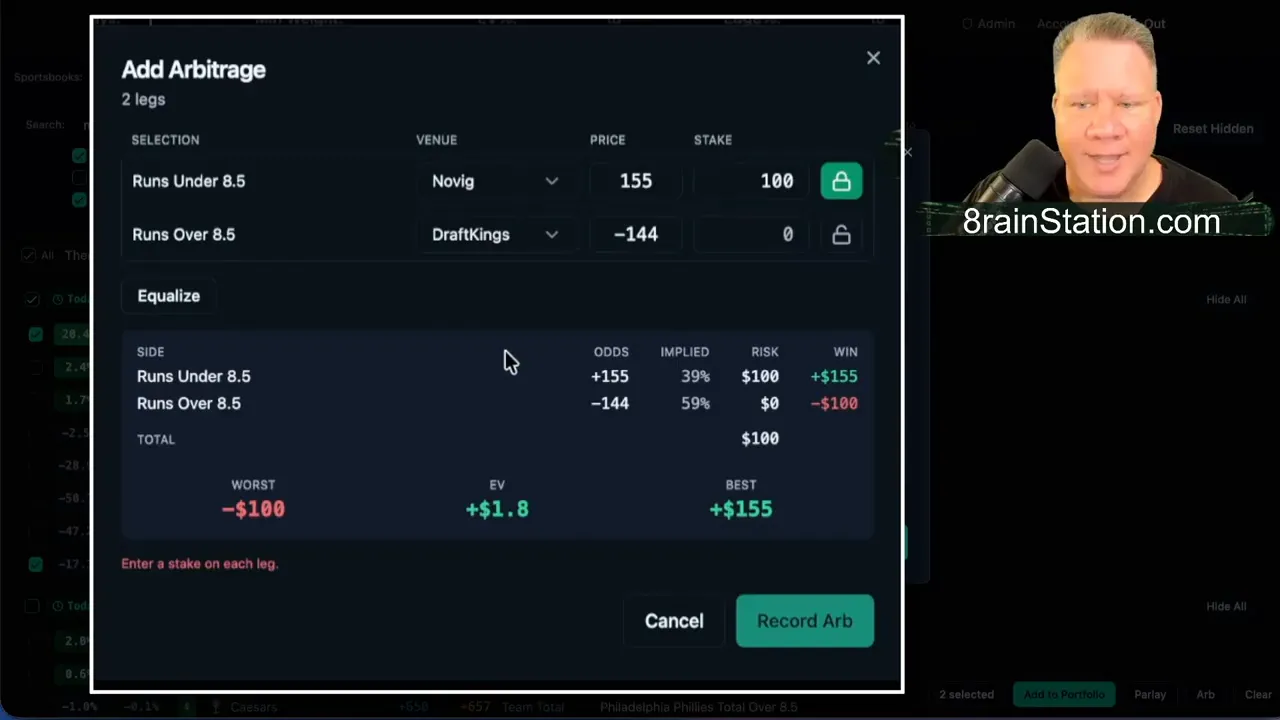
In the workflow shown, the tool lets you enter one side, adjust price assumptions, set stake, hit equalize, and immediately see the resulting range of outcomes. That includes:
- Worst case return
- Expected return
- Best case return
That is exactly the kind of functionality you need because it lets you think in distributions, not fantasies.
Sometimes equalizing the position produces a narrow guaranteed range. Other times you deliberately keep one side a little larger because you have a directional view. The point is that you can now model that choice rather than guessing your way through it.
Why this portfolio mindset is more professional
At its core, this whole approach borrows from portfolio management because the underlying problem is the same.
A portfolio manager does not just ask whether one asset looks attractive. They ask how each position fits into the whole, how much total risk is being carried, what kind of correlation exists, and whether the current allocation matches the objective.
Sports betting at a serious level is no different.
You are managing risk. That is the game.
You are not there to chase action. You are not there to mash every green number that pops on a screen. You are there to identify worthwhile opportunities and then structure them in a way that makes sense for the full day, the full bankroll, and the full process.
What is coming next makes the framework even stronger
Several forward looking features are part of the same vision.
The roadmap discussed includes more ways to manipulate the whole portfolio at once, richer groupings, stronger market classification, and more performance metrics. That includes the possibility of comparing how the model performs in certain market types versus how the market itself behaves, including probability scoring and broader historical breakdowns.
The point is not feature bloat. The point is giving better tools for answering better questions.
Questions like:
- How has this kind of play performed historically?
- How does this market behave relative to model confidence?
- What kind of exposure am I repeatedly taking?
- Where am I strongest, and where am I merely busy?
That is how serious strategy evolves from cleverness into real operating discipline.
This is also a philosophy, not just a feature set
There is a bigger argument underneath the software demo.
The betting world is full of noise, bad incentives, and sloppy habits. Plenty of people are being pushed toward compulsive behavior instead of analytical behavior. The response to that should not be moral panic. It should be better process, better tools, and a more serious understanding of what game is actually being played.
Done right, this is an analytics contest. It is decision making under uncertainty. It is bankroll management. It is discipline. It is creative problem solving. And it is far more interesting when approached that way.
It is not just about making sharper bets. It is about replacing chaos with structure.
The real edge is learning how to think at the portfolio level
If there is one takeaway here, it is this:
The mistake nearly everyone makes is treating each bet like an isolated coin flip.
The fix is to think in terms of daily exposure, portfolio construction, pruning, sizing, and execution. Search for opportunities, yes. But do not stop there. Shape them into something intentional.
That is how serious bettors operate. That is how better risk decisions get made. And that is how building better sports gambling strategies starts to become an actual craft instead of a string of random wagers.
If you want to explore the platform behind this workflow, you can apply for membership here.