Next Gen Advantage Sports Betting Is Here: How to Win in the World of AI
Next Gen Advantage Sports Betting Is Here: How to Win in the World of AI
AI is everywhere now.
Every tout suddenly has an algorithm. Every pick seller is now "AI powered." Anybody can ask a chatbot what to bet today and get an answer in two seconds.
That does not mean AI is the easy button for sports betting success.
It does mean the game has changed.
If you want a real edge now, you cannot live off hand to mouth betting. You cannot just chase a bigger price, ask for a pick, smash a button, and pretend that counts as a process. The people who are going to win in this environment are the ones using better analytics, better structure, better execution, and better decision making.
That is the whole point of next generation advantage betting.
AI can generate picks. That is not the hard part.
The basic problem most betting tools solve is not actually the important problem.
Anybody can generate picks. Touts have done that forever. A chatbot can do it now. Even simple software can compare one number to another and tell you which side looks better.
That is step one. It is not the whole game.
A lot of tools in the market are still one dimensional. They are basically price shoppers. They look at one book, compare it to another, and spit out a play. That can be useful, but it is thin. It is shallow. It is not enough if your goal is sustained, professional style advantage betting.
The real question is not just, "Where is a better number?"
The real question is "Where is the market wrong?"
The real game is finding truth before the market fully gets there
Markets tend toward efficiency, but they do not magically begin at truth.
Think about the stock market. It moves around constantly because it is trying to discover what things are actually worth. Over long stretches, you can see a general path. Day to day, though, it bounces all over the place because price discovery is messy.
Sports markets work the same way, except they have even less time to settle.
A game might only have hours, or maybe a day, for the market to absorb everything. Injuries happen. Lineups shift. Situations change. The market reacts, but it does not always land cleanly on the truth before the event starts.
That short time window is where opportunity lives.
Advantage sports gambling is about identifying disagreement between your understanding of reality and the market's current price. You want the best available number, of course. But getting the best number on a bad idea does not help you. The bigger objective is to find spots where the market has not fully priced the truth yet.
Sports betting should be treated like capital deployment
This is where the mindset changes.
If you are serious about this, you are not just collecting random bets. You are deploying capital.
Every day, the question is something like this:
- How should I allocate bankroll today?
- Which opportunities offer the best expected return?
- How aggressive or conservative do I want to be?
- Do I want more stability, or am I optimizing for maximum long term growth?
- How much correlation risk am I taking across the slate?
That is a very different mindset from chasing a pick and hoping for entertainment.
You do not need to fire your entire bankroll every day. You do need a rational process for deciding what deserves capital and how much. That is what turns betting from impulse into portfolio management.
What the new 8rain Station® is trying to solve
The rebuilt 8rain Station® is designed around that bigger process.
Not AI picks.
Not blind trust.
Not a magic black box.
The idea is to help you define truth, find disagreement with the market, narrow the slate, execute efficiently, track what you did, and improve over time.
The current release keeps the core workflow familiar, but it is the launch point for a much broader system. The foundation is there now, and more portfolio level tools are being built on top of it.
How the daily search process works
The search page is where daily opportunities are found.
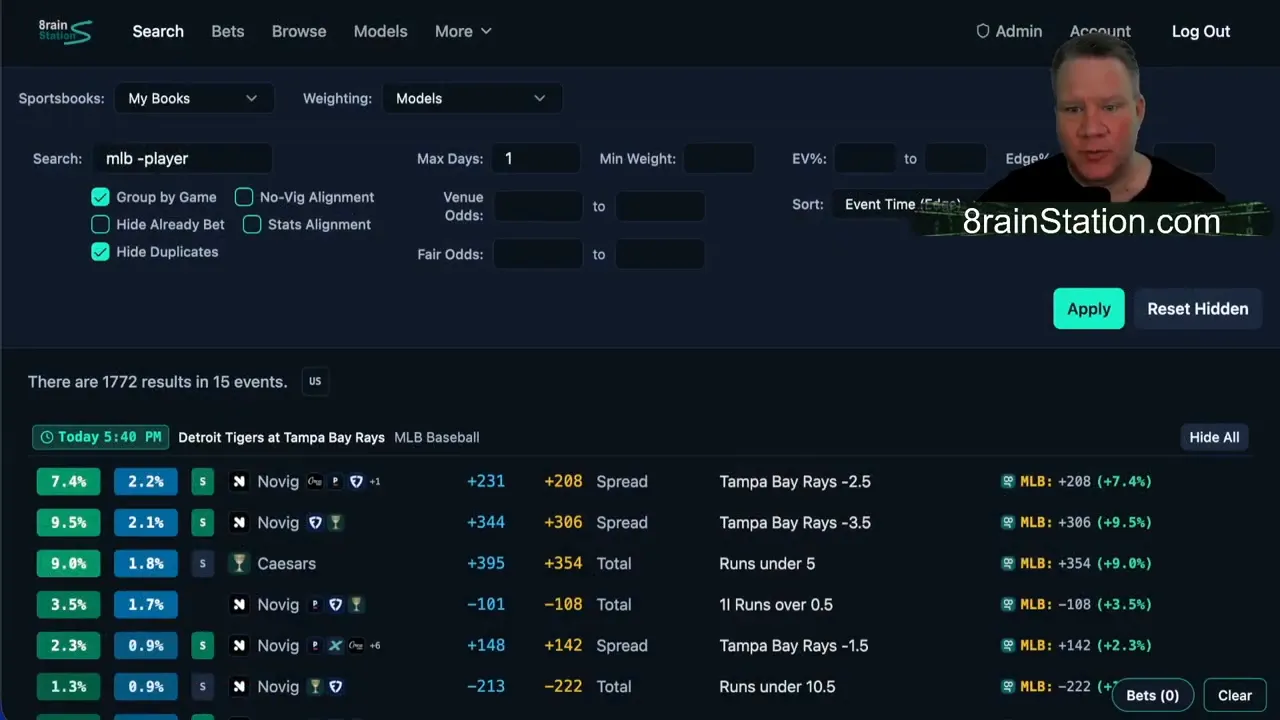
In the walkthrough, the setup uses a broader demo collection of betting venues plus an MLB predictive model. Player props are turned off for the example, results are grouped by game, and duplicate lines are hidden so multiple venues can be consolidated into cleaner rows.
Some of the important search controls include:
- Venue odds range so you can limit the prices you are willing to play
- Fair odds range if you want to screen based on model price instead of market price
- EV percent for expected return on stake
- Max EV percent to cap situations where a model may get noisy or where you want to avoid extreme outliers
- Sort modes including newer venue oriented sorts
- Grouping by game to make slate level pruning easier
One useful terminology change is the shift from "books" to venues. That matters because execution is no longer limited to traditional sportsbooks. Depending on the market, plays may exist across books, prediction markets, peer to peer venues, sweepstakes style products, and more.
That broader view matches where the market is going.
Why edge matters more than just EV
One of the more important concepts in the platform is the distinction between edge and EV.
They are related, but they are not the same thing.
Edge is the gap between what your model says the true win probability is and what the market implies.
EV is that advantage translated into return on stake.
That sounds similar until you realize what happens across the odds spectrum. Longer shots can produce inflated EV because the payout is bigger. A modest probability gap on a big underdog can create a flashy ROI number. Meanwhile, a favorite with a meaningful probability edge may show a lower EV simply because the return per dollar staked is smaller.
That is why edge is so valuable as a comparison tool. It gives you a more normalized way to compare opportunities across favorites and underdogs.
EV still matters. Of course it does. But if you only sort by EV without understanding what it is doing, you can get pulled toward longshot noise or weird outliers that are less useful than they appear at first glance.
This is one of those places where better metrics lead to better decisions.
Start broad, then tighten the search
When you run a broad search with no thresholds, you get the whole landscape. In the MLB example, that returns thousands of results across a limited number of games.
That is not meant to be your final betting list. It is the universe of possibilities.
From there, the workflow becomes selective:
- Start wide enough to see the shape of the slate.
- Apply a minimum edge threshold.
- Limit the odds range to the prices you are actually willing to bet.
- Review by game so you can see where the model is strongly aligned and where it is not.
- Prune out weaker or overly correlated plays.
In the demo, the search is tightened to plays with at least a 4 percent edge and a venue odds range between roughly minus 200 and plus 500. That turns a giant list into something much more workable.
And something immediately becomes clear: not every game offers the same amount of opportunity.
Some games barely light up. Some are full of possibilities. That is exactly what you would expect from a good model. You do not want forced action. You want selective disagreement with the market.
Request access to 8rain Station®
Get the next generation advantage betting workflow with invite-only access and a 3-day free trial if approved.
Walking through a real bet from search to execution
One example in the MLB slate is a Padres versus Phillies moneyline.
The point of the example is not that this is the most dramatic edge on the board. It is actually useful because it is relatively clean. The model prices the game close to a coin flip, while one venue is hanging a much better underdog number than the rest of the market.
Once you click into the bet details page, you can inspect the full setup:
- Core game and market information
- Stat context
- Line history
- Visual breakdown of available prices across venues
- Market hold and width information
- Model probability and derived fair odds
- The best current execution venue
That is what a serious betting workflow should look like. You are not being told what to do in the dark. You are being shown the case for the play.
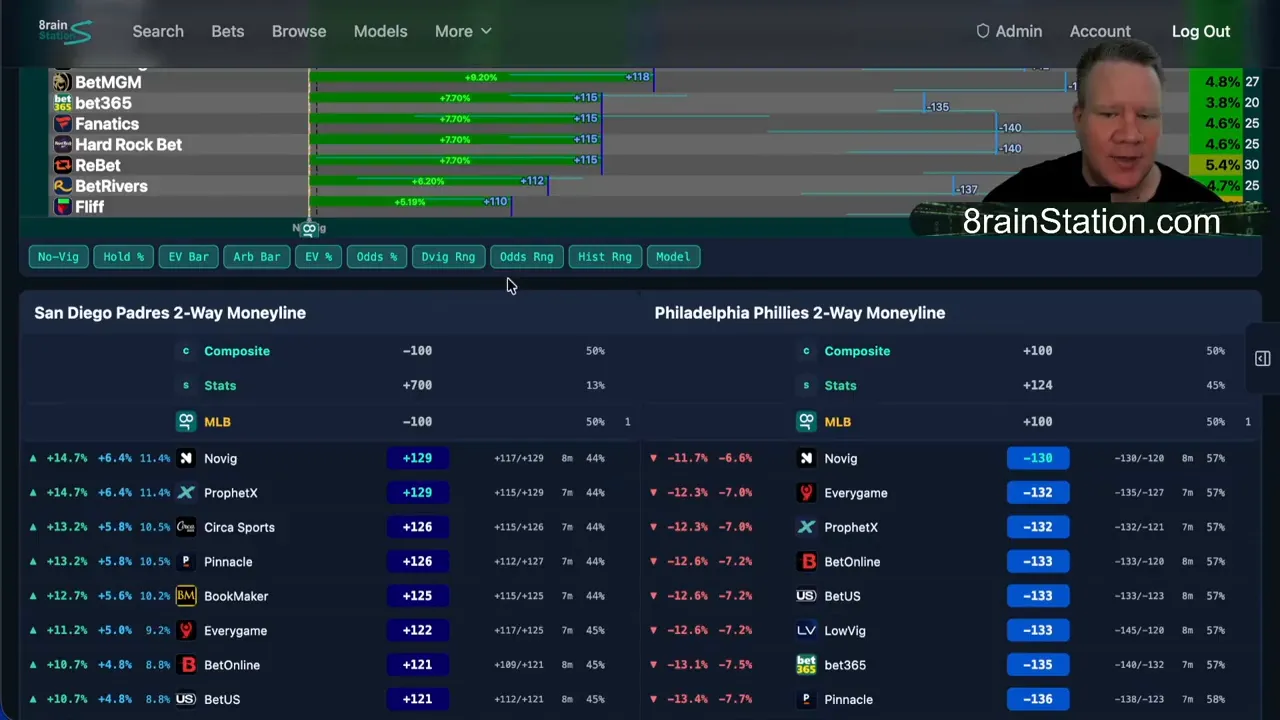
In this specific example, the model sees the game around even money while one venue offers a noticeably better plus price. That creates both an edge percentage and an EV estimate for the play. From there, the bet can be recorded directly in the tool.
Tracking bets without tipping off the books
Once a wager is entered, it appears in your tracking workflow so you can monitor what you have already played and review results later.
That might sound ordinary, but there is an important philosophy behind how this is being handled.
The platform does not want to connect directly to sportsbooks in a way that advertises exactly what kind of bettor you are. If a book can infer that you are using specialized tooling to hunt edges and monitor performance in a disciplined way, that is not information you necessarily want to hand over.
So instead of chasing the convenience of direct sportsbook integrations, the approach is to track bets on the platform side and eventually grade them from game results. That gives you the record keeping without volunteering unnecessary signals to the venues you are betting into.
That matters if you are trying to play a long game.
Some markets are stronger than others
Another point from the walkthrough is that not all markets behave the same.
The example calls out first inning baseball markets, especially the popular no run first inning angles, as a place where public assumptions can get sloppy. A lot of people lean on simplistic narratives about starting pitchers and clean opening frames. The model does not care about that story. It cares about the actual probability.
That is where quantification becomes powerful.
If a market is consistently mispriced, and your model is strong at estimating the real likelihood, you do not need vibes. You need repetition and discipline.
That is another reason generic AI picks fall short. They usually do not show whether they understand the structure of a specific market or just generated an opinion that sounds plausible.
Think in portfolios, not isolated bets
This is probably the biggest shift in the entire piece.
The goal is not just to identify good individual bets. The goal is to construct a good daily portfolio.
That means asking:
- How many bets are tied to the same game?
- Which plays are highly correlated?
- How much total bankroll is exposed today?
- What is the potential upside if things go right?
- What does my downside look like if the slate goes badly?
You might choose to take on heavier game correlation if you are intentionally maximizing upside. You might choose to diversify more if you want steadier day to day results. Either approach can be valid if it is deliberate.
What does not make sense is stumbling into correlation without realizing it.
The larger vision for the platform is to make that portfolio construction process faster and clearer, so once you know your strategy rules, you can apply them quickly across the full slate.
Strategy design and strategy execution are different jobs
This is one of the smartest distinctions in the workflow.
You do not design your strategy in the middle of execution.
Those are different mental tasks.
Strategy design is where you decide:
- What minimum edge you want
- What EV range you prefer
- What odds bands you allow
- What statistical context matters to you
- How you want to handle correlation and position sizing
Strategy execution is where you follow the plan consistently and collect data on the results.
If you are inventing rules in real time, you are usually just rationalizing emotion.
Good process means you build the decision matrix first, then execute it cleanly, then review what happened later so you can refine it with evidence instead of impulse.
How to speed up execution when you have a lot of plays
Execution friction matters more than people think.
If you only place a handful of bets, switching between tabs and venues is annoying but manageable. If you are placing a large slate, that gets expensive fast in terms of time, focus, and mental energy.
One useful tactic shown in the workflow is to first prune your list by game, then ungroup the results and sort by venue. That way, instead of bouncing endlessly between tabs, you can process all the bets for one venue in sequence, then move to the next.
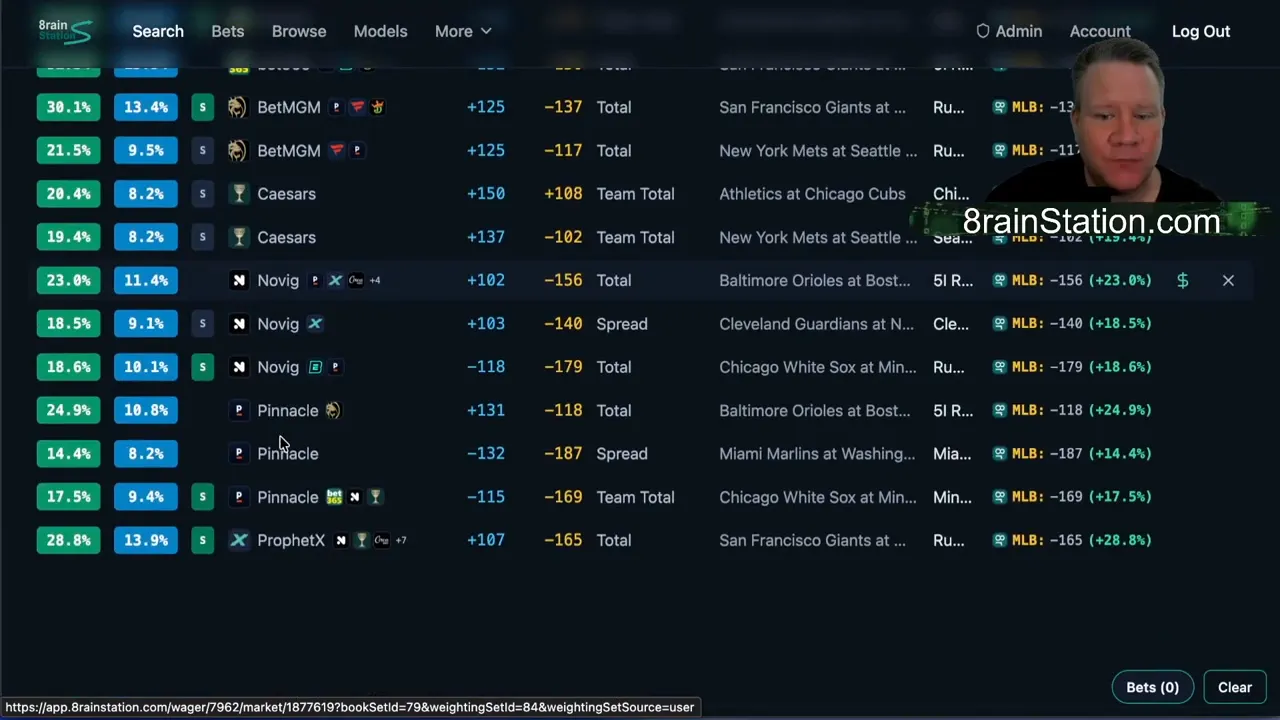
That may sound minor, but it adds up when you are entering dozens or even hundreds of wagers.
And again, the platform intentionally avoids aggressive automation tricks like deep links that could create terms issues or make your behavior too obvious to the books. The goal is not to break rules. It is to use better analytics and cleaner process inside the rules.
That is an important distinction.
Why AI alone will not save you
AI increases speed. It does not guarantee correctness.
In fact, one of the funniest and most important realities right now is that AI lets people fail faster and at greater scale. If your method is weak, adding speed just helps you lose money more efficiently.
Speed without substance is dangerous.
That is why black box pick tools are such a problem. They promise magic. They rarely show the work. They throw out a recommendation without helping you understand the underlying disagreement with the market, the actual probability, the risk structure, or the strategy framework behind the play.
That is not enough.
The software should help you think better. It should not replace thinking.
The bettor is still the one making the decision. The tool should expose truth, quantify disagreement, and support disciplined execution.
If it just spits out a pick and asks for trust, that is not an edge. That is outsourcing judgment.
For more on building models responsibly with AI, see AI Sports Betting Models: The Honest Truth Nobody Tells You and How to Build a Sports Betting Model With AI.
Why 8rain Station® is invite only now
There is also a practical reality in advantage betting: useful edges cannot be exploited infinitely by an unlimited crowd all doing the exact same thing.
If a platform is genuinely powerful, access management matters.
That is why the service is now invite only. The idea is not just exclusivity for the sake of it. It is about protecting the ecosystem and making sure the people coming in actually want to learn the craft rather than just consume a feed of picks.
The kind of person this is built for is someone who wants to improve, understand the game, and build repeatable skill.
You do not need to know everything on day one. But you do need the right mindset.
A better way to compete in an AI driven betting market
You are not just competing against casual bettors anymore.
You are competing against sharper workflows, faster tools, and automated systems that can react instantly. If your whole approach is just racing for stale prices, the machine usually wins.
So do not try to outrun the machine.
Outthink it.
Use deeper analytics. Build better models. Create more thoughtful filters. Understand market structure. Manage bankroll like capital. Track results honestly. Improve your process over time.
That is where the durable edge comes from.
If you want more detail on related parts of the workflow, the platform also has deeper resources on building your own model with AI, a full pre-game workflow walkthrough, and a private member Discord where results and ideas are shared inside the community.
Final thought
The future of advantage sports betting is not AI picks.
It is a professional process.
Define truth. Find where the market disagrees. Choose the right plays. Size them intelligently. Execute efficiently. Learn from your own data. Repeat.
That is the edge.