Does it Ever Make Sense to "Cash Out" Sports Bets? (or Hedge Your Trades with Prediction Markets?)
Building better sports gambling strategies means looking past the friendly cash-out button and asking the only question that matters: what is this position actually worth right now?
Sportsbooks make cashing out ridiculously easy. That convenience is exactly why it deserves scrutiny. In betting, the things that are easiest for us to do are often quite good for the sportsbook. Parlays fit that pattern. Cash outs fit that pattern too.
That does not mean every cash-out offer is automatically terrible. Sometimes an offer can be useful, or even favorable against your own estimate. But a cash out is never magic. It is simply an opportunity to replace your current ticket with a new position at the current game state, usually with a price charged for the privilege.
What a Sportsbook Cash Out Really Does
A cash-out offer lets you close a bet before the final result. The offer may be above or below your original stake, depending on how the game has developed. Press the button and the sportsbook gives you a certain outcome instead of the uncertain one still attached to your ticket.
That certainty can feel valuable. But the number on the screen hides the math that should drive the decision. Before accepting any offer, separate three things:
- Your original stake: What you risked when you placed the bet.
- Your live fair value: What the ticket is worth based on its current probability of winning.
- The cash-out offer: The sportsbook's price to remove your remaining exposure.
The fact that an offer is close to your original stake does not make it fair. Likewise, taking less than your stake is not automatically a bad choice. The only useful comparison is between the cash-out amount and the estimated fair value of holding the live ticket.
A Live Baseball Cash-Out Example
Consider a $50 wager on over 7.5 total runs at standard -110 odds. At that price, a winning ticket generates $45.45 in profit, for a total return of $95.45. A losing ticket loses the original $50.
Now it is the bottom of the ninth. The score is tied 3-3, runners are on first and second, and the home team is threatening. One run would bring the total to seven and leave the over ticket short. Two or more runs would make the over a winner immediately.
The sportsbook offers a $45 cash out. Accepting means locking in a $5 loss.
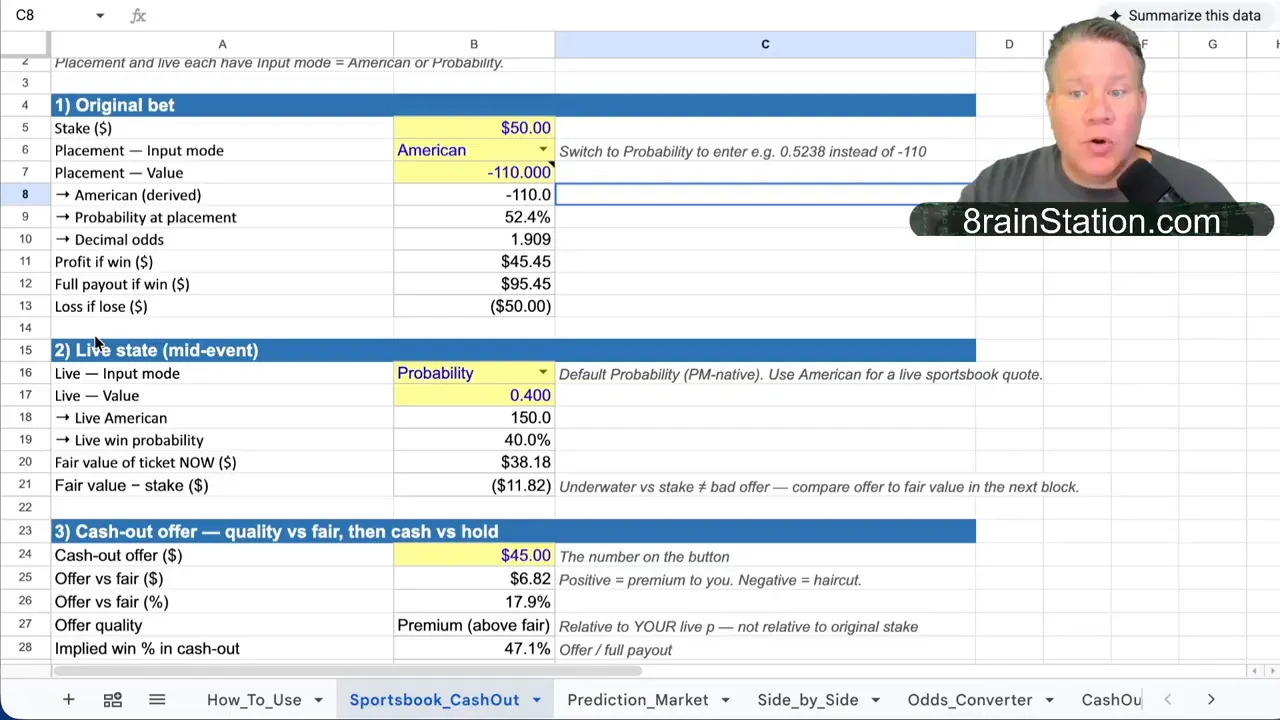
At first glance, the offer can look reasonable. You risked $50, and the sportsbook is offering $45. But the right way to evaluate it is to assign a realistic probability to the ticket winning from this exact game state.
Calculate the fair value of holding
Suppose your best estimate is that the over has a 40% chance of winning. The ticket's expected gross value is:
0.40 × $95.45 = $38.18
That means the ticket is worth about $38.18 at that moment. Relative to the original $50 risk, its expected net value is negative $11.82. The possible outcomes are still the same, either a $50 loss or a $45.45 profit, but the weighted expectation has changed because the live probability has changed.
Against that 40% estimate, the $45 cash-out offer is actually favorable. It gives $6.82 more than the estimated fair value of holding:
$45.00 cash out minus $38.18 fair value = $6.82
So yes, under that assumption, taking the cash out makes sense. It locks in a smaller loss than the loss implied by your current expected value.
The Entire Decision Rests on Your Probability Estimate
Here is the catch. What if the chance of winning is not 40%? What if it is 50%?
At a 50% win probability, the fair value becomes:
0.50 × $95.45 = $47.73
Now the $45 cash out is a worse deal than simply holding the ticket. The offer did not change. Your estimate of truth changed.
This is the uncomfortable part of building better sports gambling strategies. It is easy to think, "I am taking only a $5 loss, so this feels good." But feelings do not establish value. You need to know whether your probability estimate is well calibrated.
Runners on first and second in a tied game may feel like a situation you understand. But can you confidently distinguish a 40% chance from a 50% chance? Sportsbooks are pricing live markets constantly, across games and books, using models and information most individual bettors do not have available in the moment.
Unless you have a concrete reason that your estimate is better, the sportsbook's offer is a warning sign, not a validation. The cash-out button is not showing you the probability, the fair value, or the margin being charged. It is simply showing you a number designed to feel actionable.
This same discipline applies to every live betting decision. For a deeper look at finding the gap between available prices and actual value, review how inefficiencies in sports betting work.
Convert Odds Into Probability
Sportsbooks typically communicate in American odds. Prediction markets generally communicate in probabilities or contract prices. To use both intelligently, you need to translate between the two languages.
A -110 line implies a probability of roughly 52.38% before considering the sportsbook's margin. In decimal odds, -110 converts to about 1.909. A $50 stake therefore produces a $45.45 profit if it wins.
At a prediction market, contracts generally resolve at $1 if the stated event occurs and $0 if it does not. A 51.9 cent contract price is effectively expressing a 51.9% probability before fees. In the example, spending $50 with a 1% fee buys approximately 95.45 contracts at an entry price near 51.9 cents, matching the payout profile of the -110 sportsbook bet.
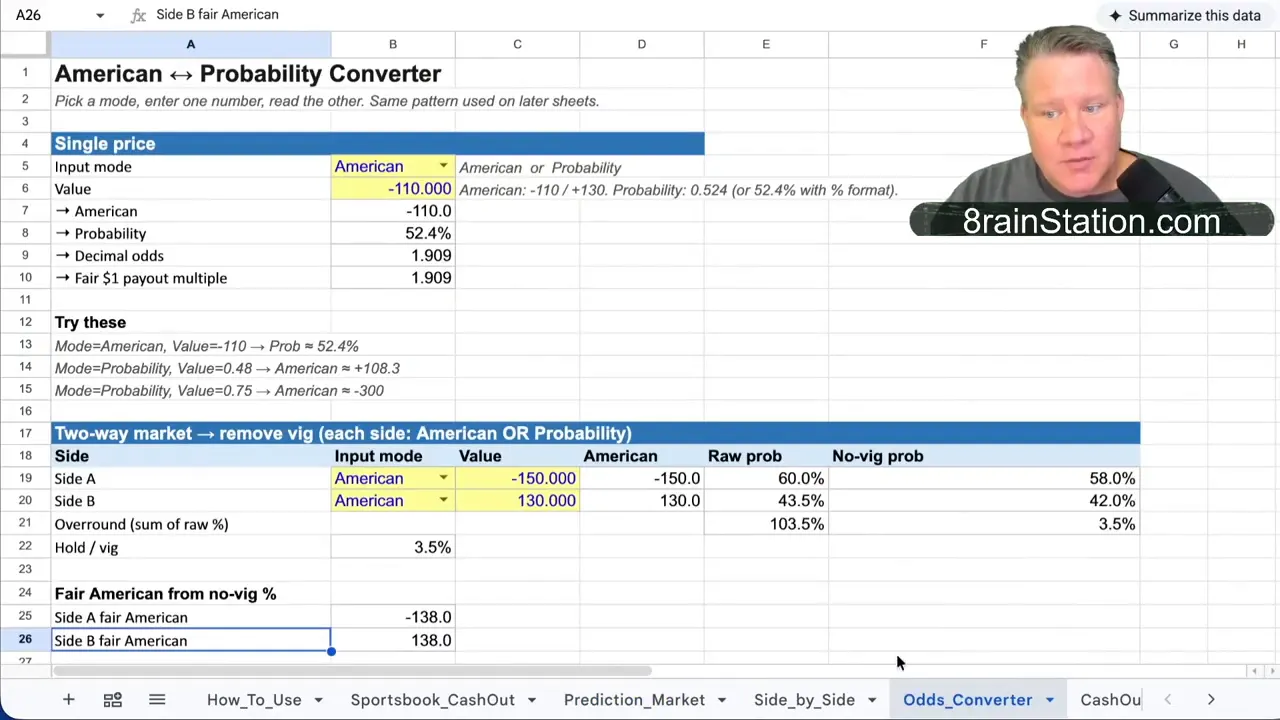
Getting comfortable with those conversions is critical for building better sports gambling strategies across sportsbooks and prediction markets. They are pricing similar uncertainty, but the interfaces speak differently.
How Prediction Market Exits Work
A sportsbook gives you a proprietary cash-out offer. A prediction market generally does not. Instead, you exit by trading out of the position.
If you originally bought "yes" contracts, you can close the exposure by selling those contracts if there is liquidity. Alternatively, depending on the structure and the position you hold, you may buy the opposing side to offset your exposure. Either way, you are not receiving a special buyback offer from a single seller. You are entering a market transaction.
This introduces two key mechanics:
- The bid: The price available to sell at right now.
- The ask: The price required to buy at right now.
The difference between those prices is the bid-ask spread. Fees matter too. In a live market, a 47 cent bid and a 52 cent ask would represent a five-cent spread. That spread is a real cost of getting in or out, particularly when the event is moving quickly.
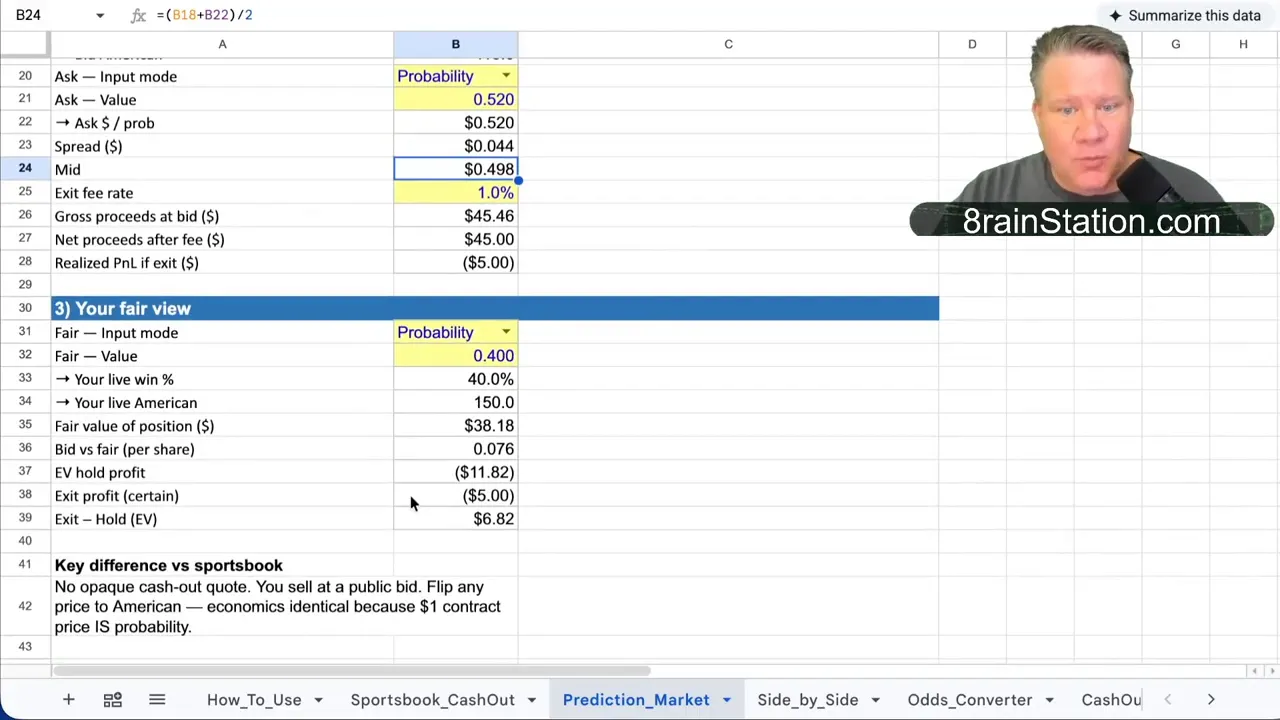
To recreate the $45 sportsbook cash out in this example, the prediction market exit would require an offsetting trade around 47 cents after accounting for a 1% fee. That trade could produce the same locked-in $5 loss.
But unlike the sportsbook cash-out button, a prediction market exposes more of the market mechanics. You can see the available price, the spread, and the cost of the hedge. That transparency is useful because it forces the question: what does the current market actually think this outcome is worth?
Use Market Prices as a Reality Check
Suppose you believe the over has only a 40% chance of winning. Yet the prediction market has a 47.6 cent best bid and a midpoint near 49.8 cents. That is a major signal.
Either the market is wrong, or your 40% estimate is wrong. It could be either. But if you have no specific edge, no better model, and no superior information, the more likely explanation is that your estimate is not as precise as you think.
Using the market midpoint as a rough proxy for a 49.8% live probability, the expected fair value of the original ticket is much closer to $47.50 than $38.18. In that case, a $45 cash out is not a great deal. The apparent value existed only because the 40% probability estimate was likely too pessimistic.
This is why a rich-looking exit should not automatically trigger action. It may represent a genuine market discrepancy, but it may also be evidence that you have misread the game state. Building better sports gambling strategies requires the humility to treat price as information.
There Is No Free Hedge
Risk management has a cost. If your original ticket is now underwater and you want to remove uncertainty, somebody has to take the other side. That person or market maker will usually demand a premium to do it.
The sportsbook has built its cash-out pricing to charge for that convenience. The prediction market charges through spread and fees. The mechanism is different, but the core reality is identical: you do not get to hedge risk for free.
That does not mean you should never hedge. Managing exposure can be entirely rational when the price is acceptable and the risk reduction matters to you. It means you should be honest about what you are doing. You are not "saving" a bet. You are placing a new trade at the current price.
And the game can change quickly. In the baseball example, the ninth inning ended, multiple runs were scored in the tenth, and the over ticket ultimately paid. Somewhere during that sequence, the ticket moved from underwater to having positive value. That outcome does not prove that holding was automatically correct, just as a loss after cashing out would not prove the cash out was wrong. The decision must be evaluated using the information and prices available at the time.
A Practical Cash-Out Checklist
Use this process whenever a sportsbook puts a cash-out offer in front of you:
- Identify the original payout. Know the total return and the net profit if the ticket wins.
- Estimate the live win probability. Do this honestly, and recognize the uncertainty in your estimate.
- Calculate live fair value. Multiply the win probability by the total return.
- Compare fair value with the cash-out offer. A higher offer is favorable only if your probability estimate is credible.
- Check an alternative market if available. Look at prediction-market bids, asks, spread, fees, and liquidity.
- Decide whether you want the remaining risk at the available price. This is not only an EV question. It is a risk-management question too.
For example, if a trade would give you more proceeds on a prediction market than at the sportsbook, that is useful information. But remember that a better exit quote also likely means the market's implied probability is higher than your earlier estimate. The edge may be tiny or nonexistent once you use the market's best estimate of truth.
For a framework on evaluating whether a price is truly worth taking, see these three steps to positive EV sports bets.
The Core Skill Is Probabilistic Thinking
At the highest level, advantage betting is always about the difference between truth and price. What do you think the actual probability is? What price can you buy, sell, or hedge at? Is the difference large enough to overcome fees, spread, and sportsbook margin?
That is the whole game.
It is not fundamentally different from poker. You assess your odds, compare them against the price or action presented, and decide whether you have an edge. The difficult part is calibrating your estimate of truth, especially in live situations where a shift from 45% to 55% is enormous but can feel nearly indistinguishable in real time.
Sportsbooks commonly build meaningful hold into their products, often in the range of 5% to 7% across the things they offer. A prediction market with a 1% fee and a modest spread may often provide a fairer way to trade or hedge. That does not guarantee an edge, but it gives you more transparent pricing and a potentially lower cost of managing a position.
If you want a clearer foundation for the exchange mechanics behind these markets, read this introduction to Kalshi trading for sports bettors.
The Bottom Line on Cashing Out Sports Bets
Cash-out offers are usually designed for convenience, not for your maximum value. Most of the time, accepting one without doing the math puts you in the sucker spot, because a single sportsbook is setting a price while hiding the assumptions behind it.
There are exceptions. A cash-out offer can be favorable against your well-supported probability estimate. A hedge can make sense because reducing risk has value to you. And a real pricing discrepancy can occasionally create an opportunity.
But building better sports gambling strategies starts with refusing to treat cash out as a special feature. It is a new trade. Calculate the probability, calculate the fair value, compare prices, include fees and spread, and ask why you believe your estimate is better than the market.
Keep learning, get comfortable with the translation between sportsbooks and prediction markets, and make the math visible before you make the decision.
For the free spreadsheet used to test cash-out and prediction-market exit scenarios, join the 8rain Discord community.